


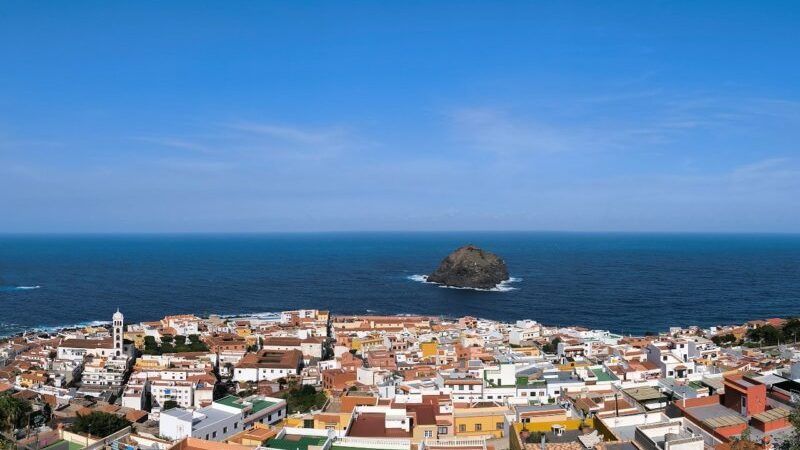
The partners of the LIFE Garachico project, led by the Ministry of Ecological Transition and Energy of the Government of the Canary Islands, headed by Mariano H. Zapata, recently traveled to the island of Terceira, in the Azores archipelago, to learn firsthand about the progress made in replicating coastal flooding adaptation measures in this area, within the framework of the European project leading the flexible adaptation of coastal urban areas in Macaronesia to climate change.
During the visit, a meeting was held workshop A technical workshop organized by the National Civil Engineering Laboratory (LNEC), the Portuguese partner in the consortium, presented the operation and results of the Early Warning System developed in Garachico. This system, a pioneer in the region, has already proven its effectiveness by providing local forecasts of coastal flooding events up to 72 hours in advance, facilitating preventive decision-making and the evacuation of people and property in at-risk areas.
He workshop The event allowed attendees to learn in detail about the integration of the Early Warning System into emergency protocols and its practical application, as well as the progress made in transferring and adapting the system to other island contexts. Furthermore, the participatory work carried out with the local population, both in Garachico and Praia da Vitória, was highlighted as a fundamental element in increasing community resilience and adapting strategies to the real needs of the region.
The event, which was attended by institutional representatives, technicians, and local stakeholders, strengthens the collaboration between the Canary Islands and the Azores to address the challenges of climate change and advance the protection of coastal communities in Macaronesia. The LIFE Garachico project, co-financed by the European Union, thus continues its roadmap to validate and transfer innovative solutions that anticipate, prepare for, and mitigate damage resulting from coastal flooding, promoting integrated and flexible coastal management.
LIFE Garachico, a European project with regional involvement
LIFE projects, aimed at safeguarding nature, are studies promoted and partially funded by the European Union, as they implement innovative actions and approaches to combating and adapting to climate change. These studies are pioneering projects that can focus on different aspects of the natural environment and climate change. In this specific case, the project focuses on adaptation in the coastal area.
Furthermore, the impact of the project has been echoed in various media outlets, such as the Canary Islands Radio and Television (RTVC), which highlighted the importance of the exchange of experiences with the Azores (see news), and The Ycoden Daute Newspaper, who highlighted how the measures developed in Garachico are being replicated in the Azores as a model for adaptation to coastal flooding (see news).