


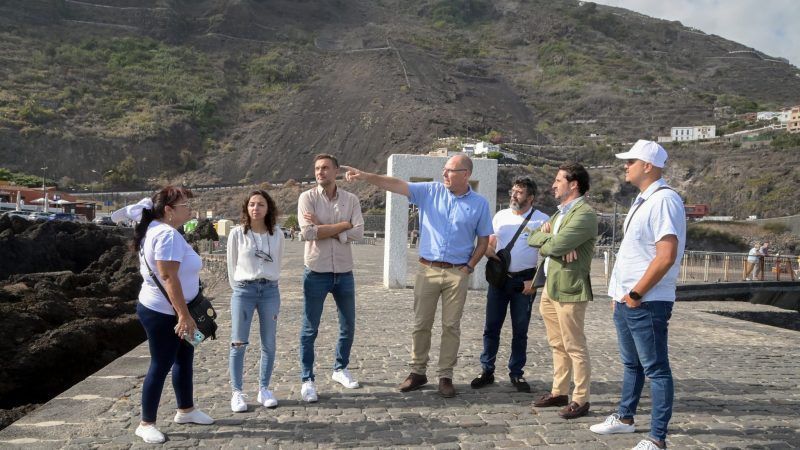
The IRIS Climate Foundation highlights the similarities between the challenges facing the Canary Islands coasts and the work they are developing within the framework of the AdaptHabana project, with which they seek to formulate an Adaptation Plan for the Coastal Zone of Havana.
Since last Monday, the Ministry of Ecological Transition has hosted various meetings to present the LIFE Garachico project to a Cuban delegation from the IRIS Climate Foundation, dedicated to implementing projects to combat climate change in Latin America and the Caribbean. This meeting to exchange experiences highlights the relevance of the approach adopted by the project, which proposes a flexible adaptation strategy to coastal flooding due to climate change, with a series of measures that are not only technically effective, but must also be acceptable to the local population. The meeting concluded with a visit on Wednesday to the coast of the municipalities of Garachico and Puerto de la Cruz, the enclaves where the project is being implemented in the Canary Islands.
The Director General of Ecological Transition and Fight against Climate Change, Ángel Montañés, has highlighted the executive's concern for "deploying effective strategies with scientific backing to increase the resilience of the archipelago's coastal urban fronts, as proposed by LIFE Garachico". In this sense, he has highlighted the importance of devoting efforts to dissemination, since the main strength of the project is that it not only develops solutions for Garachico but also proposes a global methodological model for coastal areas that suffer flooding events, as is the case of the interest shown by the Cuban delegation". He also highlighted that "we are currently replicating adaptation measures in Puerto de la Cruz and Praia da Vitòria in the Azores, but our will is to reach other territories that share the same problems thanks to the lessons learned".
The IRIS Foundation delegation is made up of scientific and technical personnel who are developing the AdaptHabana project, financed by the Green Climate Fund with the support of the UNDP in Cuba, which aims to formulate an Adaptation Plan for the Coastal Zone of Havana. This ambitious project seeks to identify the risks and vulnerabilities of each sector and population group, adopt adaptation measures and investment decisions, and covers different ecosystems, 6 municipalities and more than 700,000 inhabitants. Its scientific secretary, Dr. Tania Merino, has highlighted “the importance of establishing collaboration mechanisms, especially with experiences that share the same challenges that we face in Cuba. Our project has a shorter time span than LIFE Garachico, so we can take advantage of the lessons learned here.” The visit is part of the collaboration agreement that the entity has signed with the Environmental Hydraulics Institute of the University of Cantabria, a partner in the LIFE project.
A pioneering project that continues to bear fruit
The LIFE Garachico project is currently in the implementation phase of measures. Among them, the implementation of an early warning system for floods stands out. This system, integrated into the alert system of the autonomous community of the Canary Islands and in collaboration with the General Directorate of Emergencies, will allow us to anticipate storms and deploy protection measures. A series of action protocols are also being designed to respond to these situations in advance, redirecting pedestrians and vehicles to minimise risks. Similarly, in Garachico, interventions will be carried out such as lowering pavements, adapting parking areas or installing anti-impact benches to reduce the energy of the impact of the waves and, consequently, the damage they cause.
Finally, all these actions are evaluated to prove their effectiveness and are documented to facilitate their exportation to other coastal territories of the Canary Islands, Macaronesia and even to coastlines worldwide that suffer similar problems, as has been demonstrated thanks to the interest from Cuba. All of this will be accompanied by training programs and forums aimed at both technical personnel and the general public.
LIFE Garachico, a project with European added value
The LIFE programme is the financial instrument of the European Union that has been supporting projects related to the environment, nature conservation and climate change in the EU for more than 30 years. The current programme, corresponding to the period 2021-2027, has a total budget of 5.4 billion euros, of which 2.5 million euros have been allocated to the LIFE Garachico project.
ADDITIONAL INFORMATION
- Project title: Adaptation to coastal flooding due to climate change through flexible strategies in urban areas of Macaronesia.
- Acronym: LIFE Garachico
- Location: Garachico and Puerto de la Cruz (Canary Islands) and Praia da Vitória (Azores)
- Duration: 2021-2026
- Grant Agreement: LIFE20 CCA/ES/001641
- EU financial contribution: 55%